Performance, Accessibility and Future Implications in Closed and Open-Source Models
Choose your intelligence limited time offer: 20% off.
1. Introduction
The year 2025 marks a period in which both closed (cloud-based) and open (local) AI models have reached unprecedented capability levels. OpenAI’s release of its first large-scale, locally executable model, gpt-oss-120B, represents a significant shift—not only in OpenAI’s own product strategy but also in the overall competitive balance of the AI industry.
While the GPT-5 family remains a benchmark for closed models in terms of performance, competitors such as Meta, Google DeepMind, Anthropic, Mistral, DeepSeek, Qwen, Solar, and Microsoft have introduced next-generation models targeting different scales, contexts, and application domains.
This article compares the latest models from both ecosystems using technical benchmarks and explores their direct impact on robotics and machine learning.
2. Closed-Source (Cloud-Based) Models – Current Comparison
| Model | Publisher | Release Year | Parameter Estimate | Context Window | Modality | Architecture | Average Performance |
|---|---|---|---|---|---|---|---|
| GPT-5 | OpenAI | 2025 | Confidential (~1T) | 256K | Multimodal | Dense Transformer + MoE | State-of-the-Art |
| Claude Opus 4.1 | Anthropic | 2025 | Confidential | 200K | Multimodal | Constitutional AI + MoE | Comparable to GPT-5 |
| Claude Sonnet 4.1 | Anthropic | 2025 | Medium-scale | 200K | Multimodal | Optimized Transformer | Upper mid-tier |
| Gemini 1.5 Pro | Google DeepMind | 2025 | ~800B | 1M | Multimodal | Mixture-of-Experts | Leader in long context |
| Grok 4 | xAI | 2025 | ~500B | 128K | Multimodal | Optimized Transformer | High speed, upper-mid quality |
3. Open-Source (Local) Models – Current Comparison
| Model | Publisher | Release Year | Parameter Count | Context Window | Modality | Architecture | Average Performance |
|---|---|---|---|---|---|---|---|
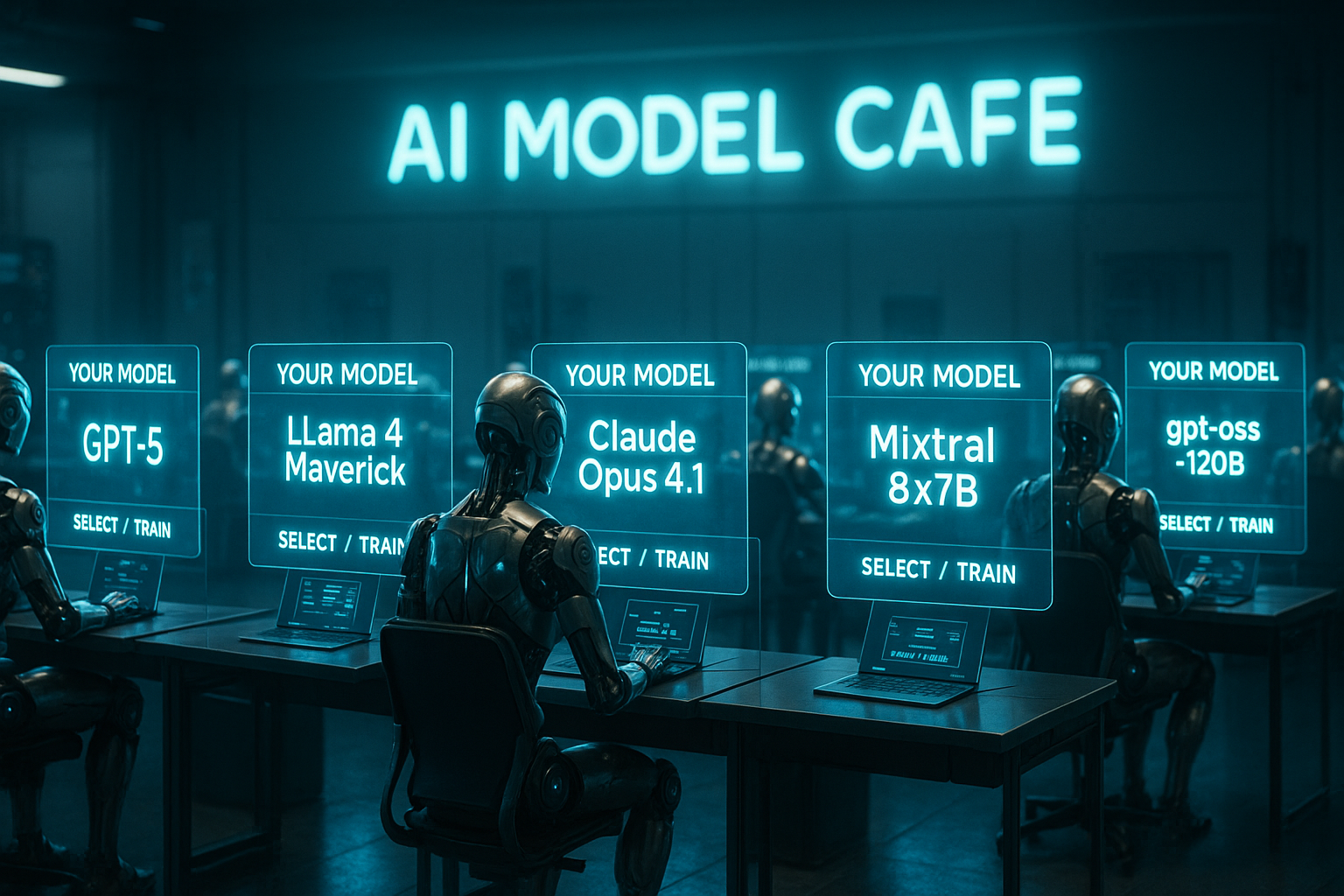
| gpt-oss-120B | OpenAI | 2025 | 120B | 128K | Multimodal | Dense Transformer | Strongest open model |
| Llama 4 Maverick | Meta | 2025 | 405B | 256K | Multimodal | MoE | High-end tier |
| Llama 4 Scout | Meta | 2025 | 70B | 128K | Multimodal | Dense Transformer | Mid-tier |
| Gemma 3 | Google DeepMind | 2025 | 27B | 128K | Multimodal | Optimized Transformer | Efficiency-focused |
| Mixtral 8×7B | Mistral | 2025 | 46.7B active | 64K | Multimodal | MoE | Lightweight and fast |
| DeepSeek-R1 | DeepSeek | 2025 | 67B | 128K | Multimodal | Optimized Transformer | Superior in math & code |
| Qwen 3 | Alibaba Cloud | 2025 | 72B | 128K | Multimodal | Dense Transformer | Strong multilingual performance |
| Solar Pro 2 | Upstage | 2025 | 27B | 64K | Multimodal | Optimized Transformer | Korean-English leader |
| Phi-2 | Microsoft | 2025 | 14B | 32K | Single modality (language) | Dense Transformer | Small device friendly |
4. Direct Impacts on Robotics and Machine Learning
The technical advancements of these models are already being applied directly in robotics and machine learning.
Closed/Cloud Models – GPT-5, Claude Opus 4.1, Gemini 1.5 Pro
- Usage: Interpreting complex natural language commands, multi-step task planning, multimodal analysis.
- Facilitations: Flexible dialogue in human-robot interaction, cloud-based strategic planning, visual-linguistic reasoning.
- Opportunities Enabled: Fully autonomous industrial robots, humanoids capable of context-driven decision-making.
Open/Local Models – gpt-oss-120B, Llama 4 Maverick, Gemma 3
- Usage: On-device control in mobile, agricultural, and domestic robots.
- Facilitations: Network-independent operation, low-latency sensor-actuator loops, local data security.
- Opportunities Enabled: Search-and-rescue robots in network-deprived areas, autonomous farming machinery in remote environments, defense and security robotics.
Specialized Robotics Models - RT-2, OpenVLA, Octo, NVIDIA GR00T
- Usage: Unifying multi-robot and multi-task control policies, integrating vision-language-action (VLA) capabilities.
- Facilitations: Rapid sim-to-real transfer, efficient multi-task policy adaptation, standardized training datasets.
- Opportunities Enabled: Faster prototype-to-field deployment, robust multitasking across diverse robotic platforms.
Key Direct Effects Across All Models:
- Reduced data requirements for learning new tasks
- Faster adaptation between different task domains
- Safe and low-latency decision-making
- Higher energy and hardware efficiency
- Shorter industrial deployment cycles
5. Conclusion and Future Outlook
The performance gap between closed and open-source models is narrowing rapidly. Expanding context windows, increasing modality integration, and strengthening local execution capabilities are pushing hybrid AI architectures combining cloud and on-device intelligence towards becoming the new norm.
The growing role of local models will enable new business paradigms based on offline autonomy and data privacy. While closed models are likely to maintain leadership in peak performance, the open-source ecosystem is accelerating innovation cycles.
In the near future, we may see distributed AI ecosystems where multiple models of different sizes operate collaboratively at the edge closer to the user enhancing accessibility and operational efficiency across robotics, industrial automation, education, and defense.
References
-
OpenAI – Introducing gpt-oss-120B: Our First Large-Scale Local Model - https://openai.com/research/gpt-oss-120b
-
OpenAI – GPT-5 Product Announcement and Capabilities - https://openai.com/product/gpt-5
-
Anthropic – Claude 4.1 Models Overview - https://www.anthropic.com/index/claude-4
-
Google DeepMind – Gemini 1.5 Pro: Advancing Long-Context Multimodal AI - https://deepmind.google/technologies/gemini/
-
Meta AI – Llama 4: Scaling Open-Source AI - https://ai.meta.com/llama/
-
Mistral – Mixtral 8×7B Technical Report - https://mistral.ai/news/mixtral-of-experts/
-
DeepSeek – DeepSeek-R1: Open Multimodal Model for Code and Math - https://deepseek.com/research/deepseek-r1
-
Alibaba Cloud – Qwen 3 Model Card - https://qwenlm.ai/
-
Upstage AI – Solar Pro 2 Multilingual Model - https://upstage.ai/solar
-
Microsoft Research – Phi-2: Small Language Models for On-Device AI - https://www.microsoft.com/en-us/research/publication/phi-2-small-language-model/
-
Google Research – RT-2: Vision-Language-Action Models in Robotics - https://research.google/blog/rt-2-new-model/
-
NVIDIA – GR00T: Generalist Robot Learning at Scale - https://developer.nvidia.com/blog/introducing-gr00t/