Introduction
For two decades, the octopus has been the patron animal of soft robotics. Engineers have admired its boneless, infinitely deformable arms, its ability to squeeze through impossible gaps, its eight-limbed coordination, and have tried, with steadily improving fidelity, to build machines that move the same way. What they have not, until now, succeeded in copying is the octopus’s far stranger gift: its mind is not where you would expect it to be.
A roughly five-hundred-million-neuron creature, the octopus keeps only about a third of its nervous system in its central brain. The other two-thirds is distributed along the eight arms themselves, where each limb can reason about touch, decide how to bend, and grasp objects with substantial autonomy. The body, in a literal sense, helps to think.
In May 2026, a team led by Barbara Mazzolai and Emanuela Del Dottore at the Istituto Italiano di Tecnologia published a soft robotic arm in Nature Machine Intelligence that takes this lesson seriously. Their arm does not merely look like an octopus. It is organized like one: each of its ten artificial suckers carries its own sensors, runs its own reflexes, and feeds a hierarchical controller that lets the limb plan a grasp without being told, beat by beat, what to do. The result is an underwater arm that finds, contacts, and seizes objects on its own, and a meaningful step toward what the field calls embodied intelligence.
The Decentralized Genius: What Makes the Octopus Different
The octopus is the textbook example of distributed cognition. Each of its arms is laced with an axial nerve cord rich enough to support local sensorimotor loops that operate without continuous oversight from the central brain. Classic experiments by Hochner, Sumbre, Flash, and colleagues have shown that a denervated octopus arm can still execute coordinated reaching motions when stimulated, as if the strategy for movement is partly stored in the limb itself.
The suckers add a second layer of intelligence. Far from being passive grippers, octopus suckers are densely innervated mechano- and chemoreceptors that taste, feel, and grip in the same gesture. They tell the arm what it is touching, how hard, and in which direction, and the arm uses that information without first sending it all the way to the brain.
This is what the field calls peripheral control, and it is the feature that has long resisted engineering. For all the elegant soft hardware built over the past fifteen years, the machines have continued to think the way computers think: centrally, sequentially, far from the action.
The Long Road from Soft Arm to Smart Arm
The first serious attempt to build an octopus came out of the European OCTOPUS project in the late 2000s, with Cecilia Laschi, Barbara Mazzolai, and their collaborators at Sant’Anna producing the first integrated soft robot arm inspired by Octopus vulgaris. By 2012 the group had demonstrated boneless, water-actuated limbs that could bend, elongate, and grasp. Subsequent generations added pneumatic actuation, embedded sensing, and suction cups designed for confined-space grasping.
Other laboratories joined the chase. Recent years have brought a wave of artificial suckers with embedded strain gauges, capacitive films, and stretchable composites, each measuring contact in its own way. A 2024 review at TU Delft cataloged the rapidly growing family of octopus-inspired suction cups, and a 2025 study introduced optoelectronically innervated suckers that detect adhesion through light. The body kept getting softer and more sensitive.
What remained missing was the architecture that the octopus uses to make sense of all that sensing. Most of these systems still ran on central control: the limb felt, but a remote processor decided. The animal’s distributed model, the very feature that gives the octopus its uncanny dexterity, had no real engineering counterpart.
A Sucker That Sees What It Touches
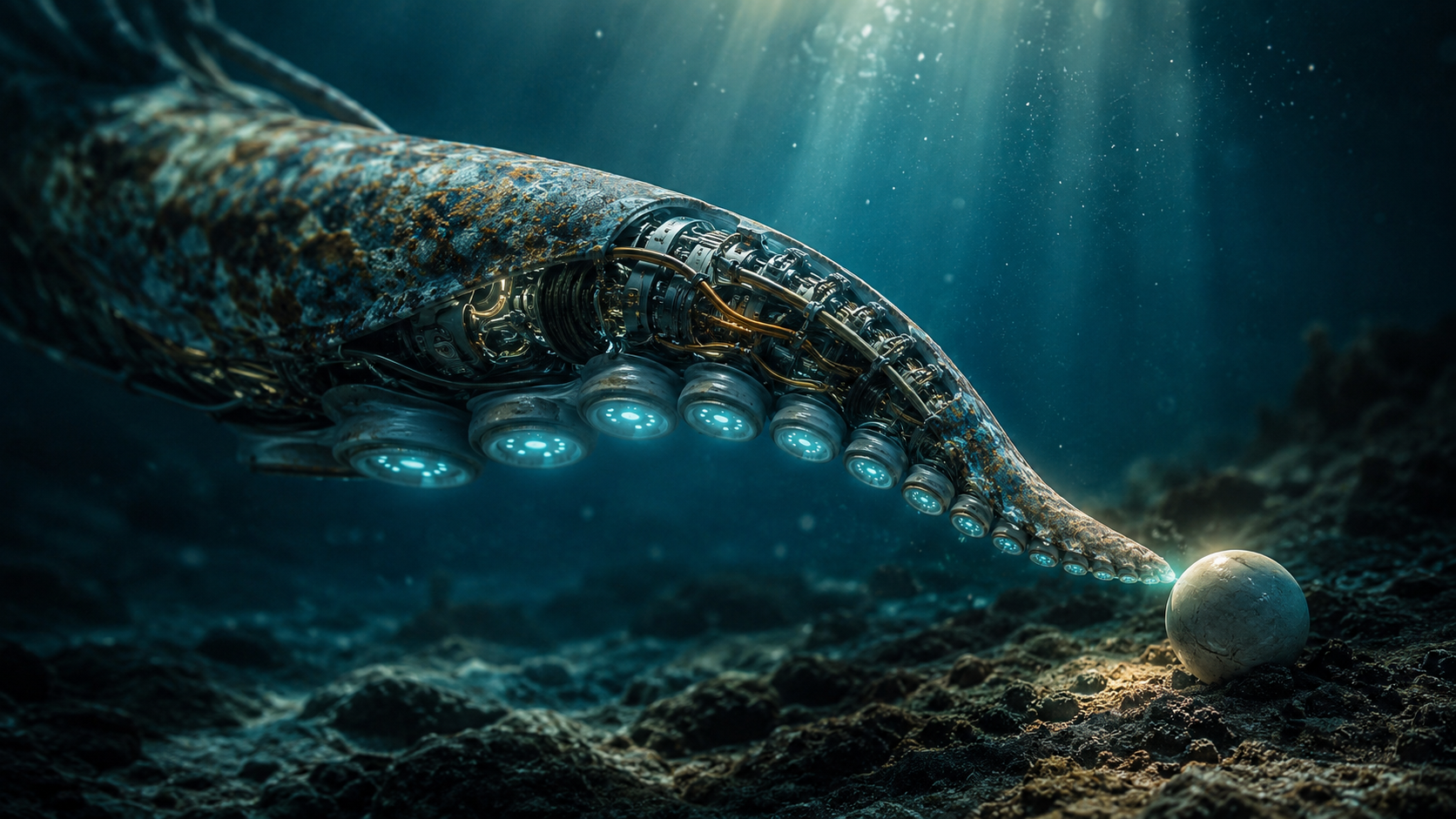
Mazzolai and Del Dottore’s arm changes that. The hardware itself is a tapered, conical limb 410 millimeters long and 40 millimeters across at the base, with ten sensorized suckers running from base to tip and shrinking from 20 millimeters to 12 millimeters in diameter as the arm narrows, much as a biological arm does.
Each artificial sucker is “innervated” with light. A small light-emitting diode shines into a soft, deformable chamber inside the cup, and an array of phototransistors reads how that light scatters as the chamber is compressed. When the sucker presses against an object, the geometry of the cavity changes, the reflected light shifts, and the change can be decoded into both the magnitude and the direction of the contact force.
The performance figures are remarkable. The sensors achieve a sensitivity of about 400 millivolts per newton in the 0 to 2-newton range, resolve the direction of contact with an error of less than 18 degrees, and behave reliably in both dry and wet environments, with minimal drift and hysteresis over time. In other words, each sucker becomes a fully fledged tactile organ, and there are ten of them arrayed along a single soft arm.
Peripheral Control: When the Arm Coordinates Itself
Sensors alone do not produce intelligence. The decisive move in the new study is what the authors do with those signals. Rather than route every contact event back to a central planner, the arm runs a hierarchical, behavior-based architecture in which each sucker carries its own local reflex loop. When a cup detects contact, it can fire an immediate adhesion response on its own, without waiting for permission.
Above these reflexes sits a global coordinator that watches the pattern of contacts across all ten suckers and decides what the arm as a whole should do: extend further, curl around an object, or commit to a grasp. The local layer handles the millisecond-scale physics of touch; the higher layer handles the seconds-scale problem of strategy. The split is, very deliberately, an engineering echo of the biological division between the arm’s axial nerve cord and the central brain.
The payoff is not just speed but a different kind of competence. Because the arm reacts where it senses, it can adapt to objects whose shape and position it does not know in advance, in conditions where a central planner would be too slow or too blind to act.
Grasping in the Dark: Autonomous Underwater Tests
To prove the architecture, the team set the arm to work in water, the octopus’s home and the place where vision is least reliable. Submerged in tanks, the limb was tasked with finding and grasping objects of varying shape and position using only its own sensorized suckers as feedback.
It worked. The arm detected contact events, estimated the force and direction of each touch, inferred the position of the object relative to itself, and closed on it in a coordinated grasp, all without external visual guidance. The performance held under the wet, salt-tinged conditions in which traditional electronic sensors often struggle.
That underwater autonomy matters far beyond an academic demonstration. It hints at a new class of marine manipulators that can work where cameras fail and tethered control breaks down: tangled wreckage, biological sampling, delicate coral surveys, infrastructure inspection in turbid water.
Why It Matters: From Soft Prosthetics to Embodied AI
The implications run in several directions at once.
For underwater robotics, a soft arm that decides for itself begins to dissolve the dependency on high-bandwidth tele-operation and crystal-clear vision that has long constrained subsea work. For prosthetics and surgery, the same principles point toward instruments whose grasp adjusts itself before the operator has to think about it. For agriculture and warehouse manipulation, the kind of delicate, contact-rich handling that breaks rigid grippers becomes feasible when the grippers themselves can feel and react.
The deeper resonance, however, is with the wider conversation about embodied artificial intelligence. Modern AI is overwhelmingly central, vast models running in distant data centers and reaching out to actuators only as an afterthought. The octopus, and now this arm, suggests another way: distribute the intelligence into the body, let the periphery handle what the periphery is best at, and reserve the center for what genuinely needs to be coordinated. It is a model of cognition that owes more to evolution than to von Neumann.
Conclusion
Soft robotics has spent fifteen years imitating the octopus’s body. Mazzolai, Del Dottore, and their colleagues have begun to imitate its organization. The arm they describe is not a clever assembly of soft materials with sensors bolted on; it is a small, deliberate piece of nervous system, with reflexes in its periphery and judgment at its top.
That structural shift is what gives the machine its new abilities. An arm whose suckers can feel, decide, and react becomes, for the first time, capable of grasping the unknown without being told how. In a tank of dark water, this is a manipulator. In the broader story of how machines come to behave intelligently, it is something more: a working demonstration that intelligence does not have to live in one place to do its job, and that the periphery, when properly organized, can think.
What other limbs of our machines, one might ask, have we been overlooking as mere actuators?
References
-
Del Dottore, E., et al. (2026). “Peripheral control enabled by distributed sensing in an octopus-inspired soft robotic arm for autonomous underwater grasping.” Nature Machine Intelligence. - https://www.nature.com/articles/s42256-026-01230-y
-
Sumbre, G., Fiorito, G., Flash, T., Hochner, B. (2005). “Neurobiology: motor control of flexible octopus arms.” Nature, 433, 595-596. - https://doi.org/10.1038/433595a
-
Hochner, B. (2012). “An Embodied View of Octopus Neurobiology.” Current Biology, 22(20), R887-R892. - https://doi.org/10.1016/j.cub.2012.09.001
-
Laschi, C., Mazzolai, B., et al. (2012). “Soft Robot Arm Inspired by the Octopus.” Advanced Robotics, 26(7), 709-727. - https://doi.org/10.1163/156855312X626343
-
Mazzolai, B., et al. (2019). “Octopus-Inspired Soft Arm with Suction Cups for Enhanced Grasping Tasks in Confined Environments.” Advanced Intelligent Systems, 1(6). - https://doi.org/10.1002/aisy.201900041
-
van Veggel, A. M., et al. (2024). “Classification and Evaluation of Octopus-Inspired Suction Cups for Soft Continuum Robots.” Advanced Science. - https://doi.org/10.1002/advs.202400806
-
van Veggel, A. M., et al. (2025). “Optoelectronically Innervated Suction Cup Inspired by the Octopus.” Advanced Intelligent Systems. - https://doi.org/10.1002/aisy.202400544
-
“Octopus-inspired sensorized soft arm for environmental interaction.” Science Robotics. - https://doi.org/10.1126/scirobotics.adh7852
-
IEEE Spectrum. “Robot Octopus Points the Way to Soft Robotics With Eight Wiggly Arms.” - https://spectrum.ieee.org/robot-octopus-points-the-way-to-soft-robotics-with-eight-wiggly-arms